What Ethereum contributes to DeFi
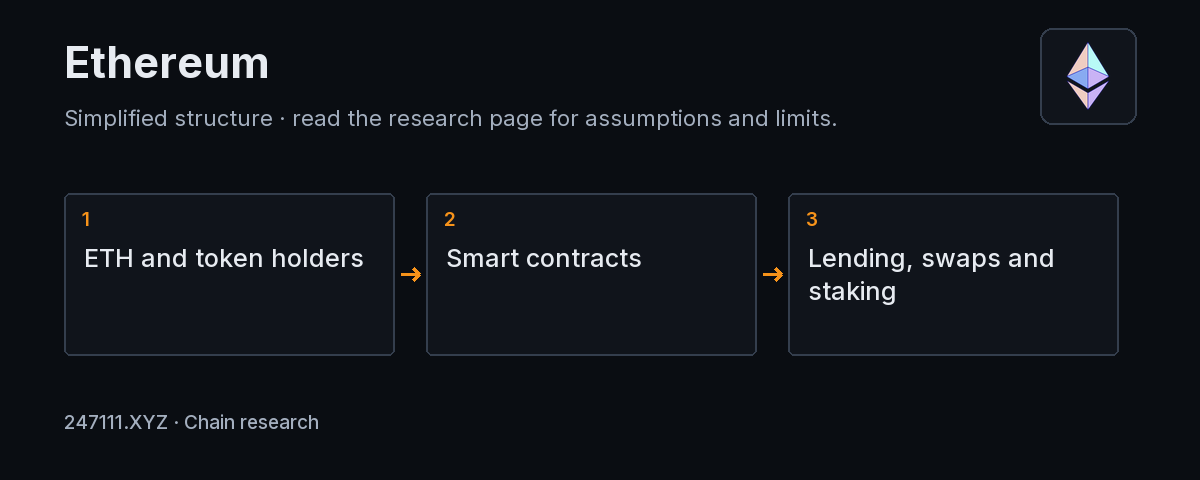
Ethereum is a programmable settlement network. Its smart contracts support lending markets, decentralized exchanges, stablecoins and liquid staking. A deposit into one of these applications follows that application's contract rules; Ethereum itself does not set every lending rate, collateral limit or withdrawal condition.
ETH, application tokens and transaction costs
ETH pays for transaction execution. Sending a token or approving a spender still requires the network's fee asset. An application governance token is a separate exposure from ETH, and holding either token does not automatically create a claim on an application's deposited capital. Contract interactions can consume more gas than a simple ETH transfer.
Read the capital and activity panels together
Chain TVL describes capital attributed to tracked applications on Ethereum, not all ETH in circulation. The protocol list can show a protocol's combined deposits across several networks, so those rows should not be added to reconstruct Ethereum-only TVL. A rise in dollar TVL can reflect higher asset prices even when deposited token quantities do not change. Compare the observed period, DEX activity and fees before describing a move as new demand.
Risks depend on the application
- Inspect contract upgrade permissions, oracle dependencies and accepted collateral for the application you are researching.
- A liquid staking token adds validator, withdrawal and secondary-market risks to the underlying ETH exposure.
- Bridging into another network introduces a different settlement path; the same token symbol does not establish the same asset or security model.