
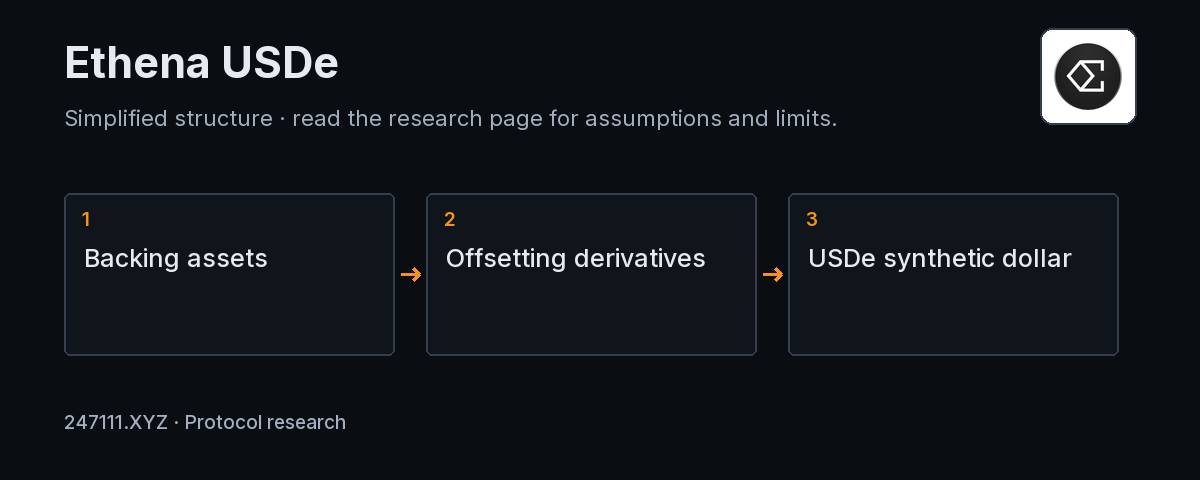
Hedging supports the dollar reference
Ethena describes USDe as a synthetic dollar supported by backing assets and offsetting derivatives positions, alongside liquid stable assets. The hedge aims to reduce exposure to changes in the underlying spot assets. This differs from assuming that every unit is a conventional bank-dollar deposit with identical custody and redemption arrangements.
USDe, sUSDe and ENA differ
Holding USDe and holding the savings exposure sUSDe are different positions. ENA token exposure is separate again. The protocol's reward sources can include staking yield, futures funding or basis, and returns associated with liquid stable assets. The existence of a hedge does not establish a fixed positive reward rate under every market condition.
Capital is not unrestricted redemption liquidity
Reported USDe capital and a quoted price close to one dollar do not show that every holder can redeem directly. Direct minting and redemption have documented eligibility conditions, while secondary-market trading depends on venue liquidity. Backing custody and hedging venues introduce operational relationships beyond the token contract.
Model the costs and the adverse case
- Consider adverse funding, hedge execution and custody or settlement disruption together.
- A secondary-market deviation and loss of backing are different problems, though either can affect an exit.
- Our depeg and funding tools illustrate supplied scenarios; they do not value Ethena's actual backing or predict redemption availability.