
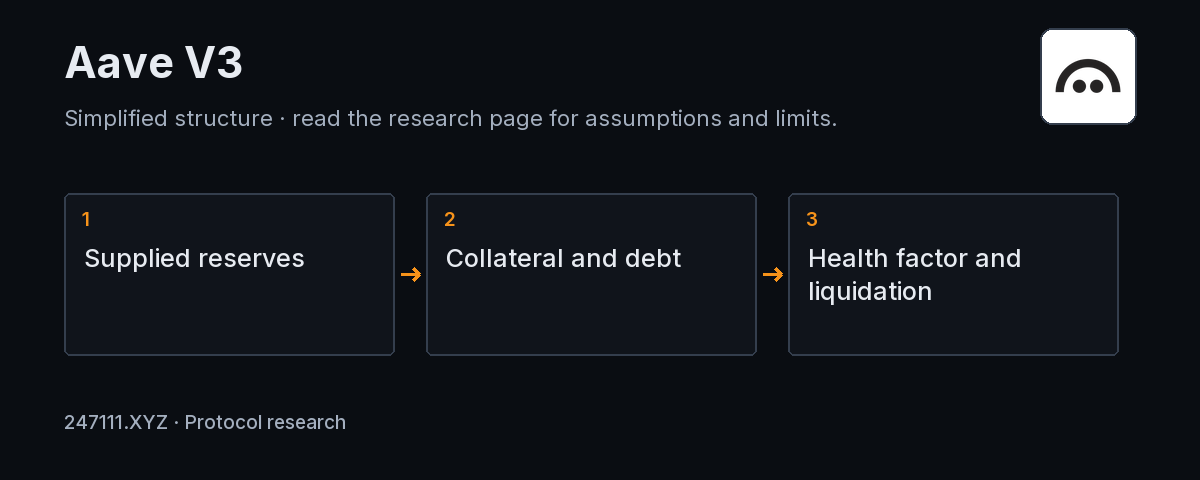
A lending pool has suppliers and borrowers
Aave V3 pools supplied assets into reserves from which eligible borrowers can borrow against collateral. Supply receipts and debt balances track different sides of the position. Interest accrues over time, and borrowing rates respond to reserve utilization. Holding AAVE is different from holding a supplied reserve asset or an aToken receipt.
Health factor is a position measurement
A health factor compares collateral value, weighted liquidation thresholds and outstanding debt. Below one, a position can become eligible for liquidation. Prices, interest and collateral settings can all move the ratio. E-Mode and isolation settings add rules that a simple multi-asset threshold calculation does not fully reproduce.
TVL is not available borrowing capacity
The protocol row can combine several deployments. An individual reserve's available liquidity, supply or borrow caps and collateral settings apply to a particular network and market. A protocol-wide dollar total therefore cannot answer how much of one token can be withdrawn or borrowed in one pool. Inspect the listed deployment before making comparisons.
Use scenarios with the right limits
- Check the current oracle and liquidation threshold for each collateral asset.
- Account for accrued debt and potential stablecoin price deviations, not only the initial borrowed amount.
- Our health-factor tool illustrates supplied assumptions; it does not read an Aave account or guarantee execution under every market mode.