Choosing swing and session inputs for price levels
Calculate supplied Fibonacci and pivot levels while keeping swing order, period boundaries and named formula differences clear.
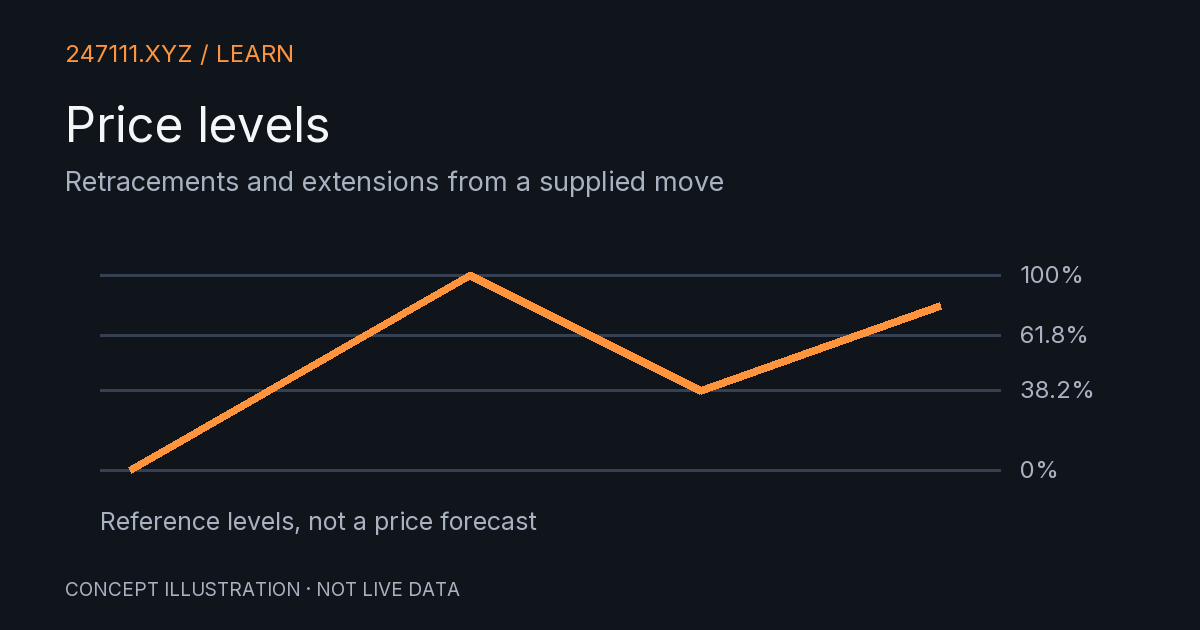
Choose the movement before the ratio
Retracement = end − (end − start) × ratioFibonacci levels depend on the swing you supply. Enter its starting price first and ending price second, even for a downward move. With 100 to 200, the signed move is 100 and a 61.8% retracement is 138.2. Reversing the swing changes the anchor; the calculator does not select highs and lows from a chart.
Two extension conventions
Projection = pullback + signed swing × ratioA two-point extension adds the signed swing to the starting price, producing 261.8 at 161.8% for the example above. A three-point projection starts at a supplied pullback within the swing range. A pullback of 150 instead produces 311.8. These labels describe different anchors, so compare the inputs as well as the ratio.
Use one session definition for pivots
Supply the previous period high, low and close from the same venue and period. Woodie additionally uses the current period open. At high 110, low 90 and close 100, Traditional gives pivot 100 and third resistance/support 130/70. Classic instead gives 140/60; their first two pairs agree. Fibonacci uses range multiples, while Camarilla centers its paired levels on the previous close. The page combines all five methods so their differences remain visible.
Read a level as a reference
The arithmetic cannot establish the probability of a reversal or fill. A flat previous range is allowed and identified. Very large downward swings can produce negative derived levels; these are retained to explain the formula, with a warning that they cannot serve as price orders. Use a separate position-size calculation for a chosen loss budget and stop.