Expiry payoff, margin boundaries and simulated loss thresholds
Keep contract payoff, isolated maintenance arithmetic and seeded binary-trade simulations tied to their stated assumptions.
Specify the option contract
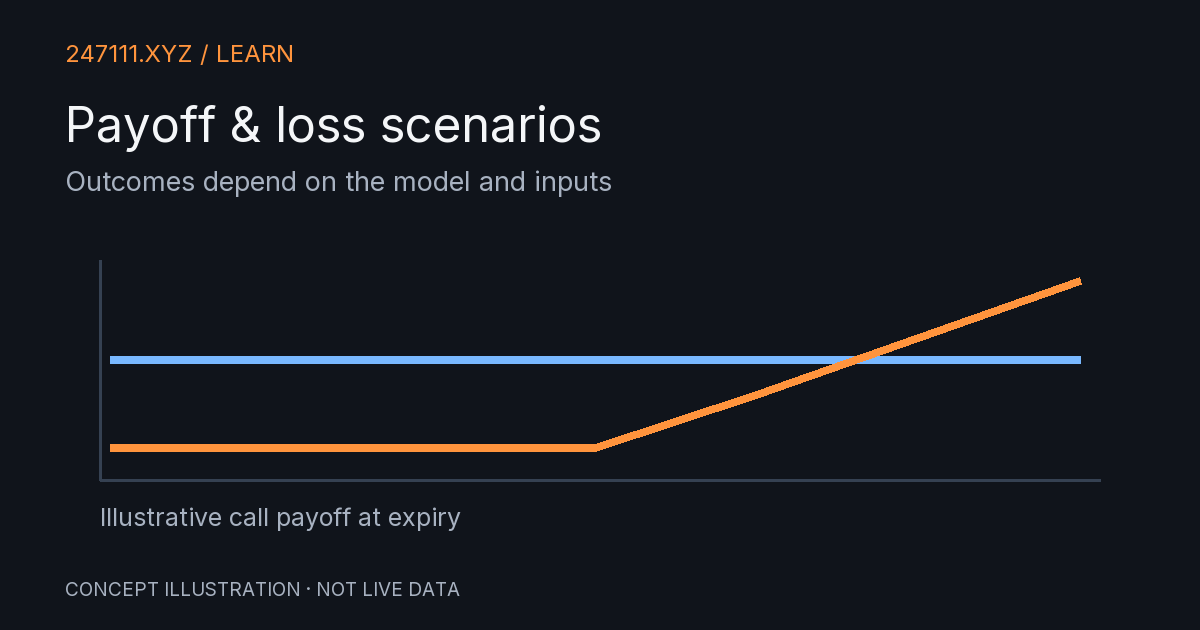
Net = signed intrinsic value − signed premium cost − total feesThe payoff tool supports a single vanilla call or put, or a vertical with two same-type legs at different strikes and opposite sides. Both legs share underlying, expiry, contract count and multiplier. Premium is per underlying unit. Supply the multiplier yourself; 100 is only an example. Results assume a fixed quote cash-equivalent settlement at expiry, subtracting total fees once. A 100/110 long call spread bought for net premium three per unit, at 100 units, has net outcomes bounded by −300 and 700 before fees, with break-even 103.
A table range does not bound risk
The tool derives extrema and break-even points from piecewise payoff segments and their tail, rather than from the maximum table price. A naked short call has unbounded loss. Zero-payoff intervals are explained separately from isolated roots. Pre-expiry pricing, Greeks, early exercise/assignment, physical delivery funding, margin and inverse settlement are excluded.
Identify the isolated margin model
Long boundary = entry − (initial margin + extra margin − maintenance) / quantityThe futures estimator supports the documented entry-notional isolated linear USDT approximation. Entry notional divided by leverage supplies initial margin; maintenance is entry notional times your rate minus the supplied deduction. For one unit at 20,000, leverage 50, maintenance 0.5% and no extra margin, the long boundary is 19,700 and zero-equity reference 19,600. It uses your supplied mark price. This does not reproduce a universal or current exchange engine: fees, funding, tier changes, mark-notional rules and cross/portfolio/inverse margin are excluded.
Define what counts as ruin
The simulator stops a trial when equity reaches a loss threshold measured from starting capital. It is not trailing drawdown. Trades have independent binary outcomes with your fixed win probability, reward and cost in risk units. Stake is a fraction of initial or current equity; equity is floored at zero. A nonzero 32-bit seed reproduces the same xorshift32 stream and stopping procedure. The Wilson 95% interval describes Monte Carlo sampling within this model; it does not validate the assumed win rate or forecast markets. All trials enter the aggregates, while the table and CSV show the first 100 summaries. Gaps, serial dependence and changing outcomes require different assumptions.