Position size, leverage and margin
Separate risk budget, asset units, position exposure and initial margin using an entry price and a planned stop.
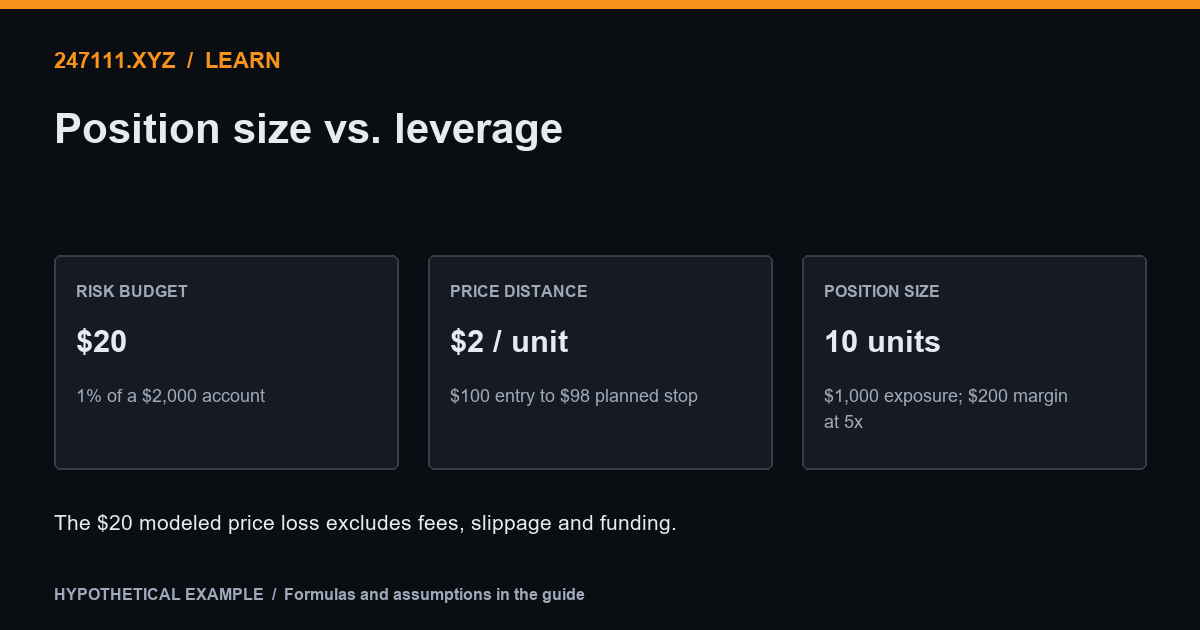
Start with a risk budget
Risk budget = account balance × risk % / 100
Price distance = |entry price − planned stop price|
Units = risk budget / price distance
Exposure = units × entry price
Initial margin estimate = exposure / leverage
Use a stop below entry for a long scenario and above entry for a short scenario. Equal entry and stop prices have zero distance and cannot produce a finite size. All prices and account amounts must use the same quote currency. The tool applies to simple linear price movement; inverse contracts have different mechanics.
A hypothetical long position
An account balance of $2,000 and a 1% risk budget gives $20. With entry at $100 and a planned stop at $98, the distance is $2. The basic size is 10 units, giving $1,000 of exposure. At 5× leverage, estimated initial margin is $200. A $2 move against those 10 units is still $20 before costs.
| Quantity | Meaning | Example |
|---|---|---|
| Risk budget | Planned loss before excluded costs | $20 |
| Units | Amount of the asset | 10 |
| Exposure | Entry value of the position | $1,000 |
| Initial margin | Exposure divided by leverage | $200 at 5× |
Fees reduce the units that fit the budget
The calculator can include entry and stop-exit fee percentages in the modeled loss per unit. With a 0.1% fee on both sides, cost per unit is $2 + $0.10 + $0.098 = $2.198. A $20 budget then fits approximately 9.10 units before venue rounding. Round down to a permitted size when a venue has a quantity increment.
A stop is a plan, not a guaranteed price
- A stop can trigger and fill at a different price during a fast move or low liquidity.
- Funding, borrowing costs and exchange-specific maintenance margin are outside the basic stop-loss estimate.
- Liquidation can occur before your planned stop. The tool does not calculate a liquidation price.
- The leverage input does not verify a venue limit or whether you have enough available collateral.
Check the actual contract specifications before placing an order. Compare units and exposure when changing leverage: holding units constant holds the price-loss estimate constant. Saving a second scenario with a wider stop will show why the same risk budget normally supports fewer units.
What changes when leverage increases?
For unchanged units and entry price, higher leverage reduces this simple initial-margin estimate. It does not reduce the modeled loss from a given price move. This tool does not calculate liquidation price, maintenance margin or venue risk tiers.
Check the inputs before comparing results
- Use the same quote currency for account balance, entry and stop.
- Include modeled entry and exit fees when fitting units to a risk budget.
- Slippage, gaps and funding can increase actual losses beyond the example.
Use the related calculator to compare your own inputs. The result is an arithmetic estimate based on the assumptions above.