Mining profit depends on output and operating assumptions
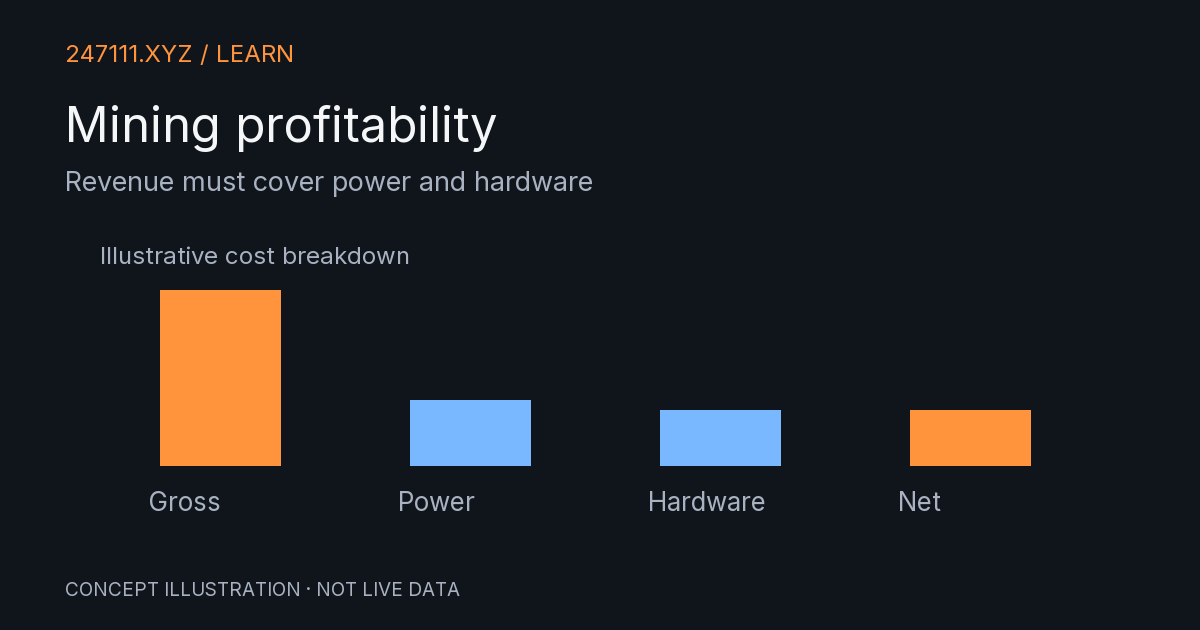
Separate coin output, active electricity costs, calendar operating costs and upfront hardware before interpreting a mining payback estimate.
Start with your output assumption
The mining calculator asks for coins mined per day at full uptime. Enter an output estimate from your own hardware and pool assumptions. The tool does not derive rewards from hash rate, network difficulty or a current block subsidy. Your estimate may change as those conditions change.
Active electricity and fixed daily costs
kWh per day = active watts / 1,000 × 24 × uptime fractionHypothetical example: 1,000 watts running all day uses 24 kWh. At $0.10/kWh that costs $2.40. At 50% uptime this model halves active electricity and coin output, while a $5 calendar-day operating cost stays $5. Idle power is excluded; incorporate it into your supplied operating costs if needed.
Revenue is different from profit
At 0.001 coins per full day, a hypothetical $100,000 coin price and a 2% pool fee, revenue after the pool fee is $98 per day. Subtract $2.40 electricity and $5 other daily costs to get $90.60 operating profit. This is an illustration of the arithmetic, not a claim that a particular machine earns those amounts.
Interpreting hardware payback
Payback days = upfront hardware cost / positive daily operating profit$1,000 of hardware would take about 11.04 days to recover at an unchanged $90.60 daily profit. When operating profit is zero or negative, there is no finite payback under these assumptions. The horizon result subtracts hardware once; it does not depreciate or resell it.
A constant-output model excludes difficulty and payout changes, halvings, future coin prices, financing, tax and changing electricity tariffs. Review those assumptions before interpreting payback. Network transaction fees are separate from pool fees and belong in your own allocated costs.