Funding payments and settlement intervals
Estimate funding for a linear perpetual position using the rate per interval and the number of eligible settlements.
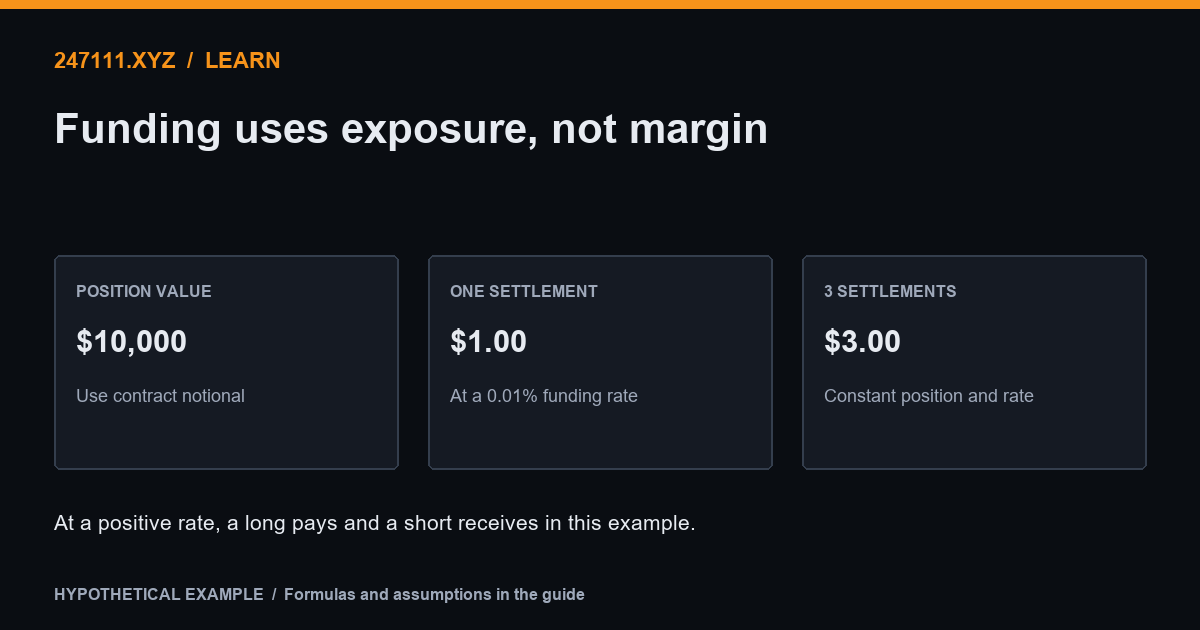
Use position value, not margin
Funding per settlement = position notional × rate % / 100
Projected total = funding per settlement × eligible settlements
For a linear contract, notional is quantity times the relevant price. A $10,000 position does not become a $2,000 funding position just because its initial margin at 5× leverage is $2,000. The tool holds the entered notional and rate constant.
A hypothetical 24-hour scenario
At $10,000 notional and 0.01% per eight-hour settlement, one settlement is $1. If the position is eligible at three settlements, the projected payment is $3 for a long at a positive rate. A short receives $3 under the same assumptions. At a negative rate, the payment direction reverses.
| Rate per settlement | Eligible settlements | Long cost | Short cost |
|---|---|---|---|
| +0.01% | 3 | $3 paid | $3 received |
| −0.01% | 3 | $3 received | $3 paid |
| 0% | 3 | $0 | $0 |
Count actual settlement boundaries
Holding for four hours does not necessarily mean half of an eight-hour payment. A venue may settle based on whether you hold the position at the funding time. Check the instrument’s current interval and schedule, then count the settlement times crossed while you expect to hold it. A duration estimate alone cannot establish that count.
Why the final exchange record can differ
- The funding rate may change between settlements.
- Mark price and position size can change, altering notional.
- Contract intervals can vary or be adjusted by the venue.
- Opening or closing close to settlement can have venue-specific timing rules.
- Inverse contracts calculate position value and pay funding in a different way from this quote-currency model.
Use the exchange transaction history to reconcile actual payments. The eight-hour-normalized market indicator on the derivatives page is useful for comparison, but it is not automatically the rate for a particular contract’s next settlement. Enter the contract’s own interval rate in this tool. Positive calculator cost means you pay; negative cost means you receive.
Can a four-hour hold still pay a full settlement?
Yes, when the venue applies funding to positions held at a settlement boundary. Enter the number of eligible settlements rather than assuming a fraction of a payment from elapsed hours. The derivatives summary normalizes rates to eight hours for comparison; the calculator uses the interval rate you enter.
Check the inputs before comparing results
- Confirm the current settlement schedule for the specific contract.
- Use position notional rather than the margin deposit.
- For a variable rate, model each settlement separately and add the payments.
Use the related calculator to compare your own inputs. The result is an arithmetic estimate based on the assumptions above.
A matched spot-long and futures-short scenario
The same funding calculator has a cash-and-carry workbench. Enter the quantity, both entry and exit prices, a signed rate per eligible settlement and total trading, borrowing and other costs. It models a spot long and a linear futures short. It does not assume the exit basis converges or infer settlement eligibility.
Hypothetical example: one unit bought spot at 100 and shorted at 105, both closed at 110, gives +10 spot and −5 futures. Three funding receipts at 0.1% of the 105 entry notional total 0.315. Costs of 2 for trading and 1 for borrowing leave 2.315. Negative funding reverses the receipt. The displayed return divides by spot acquisition value, not futures margin, and is not annualized.