Crypto profit after buying and selling fees
Calculate the cost of buying, the proceeds from selling and the price needed to break even. Includes a worked spot-trade example.
Use the quantity that reaches your account
This guide models a spot purchase with fees paid in the quote currency, such as USD or USDT. If an exchange takes the buying fee from the asset instead, enter the quantity left after that deduction and record the actual cash spent. Do not count the same fee twice.
Buying cost = quantity × entry price × (1 + buying fee % / 100)
Selling proceeds = quantity × exit price × (1 − selling fee % / 100)
Net profit = selling proceeds − buying cost − other costs
A hypothetical trade, step by step
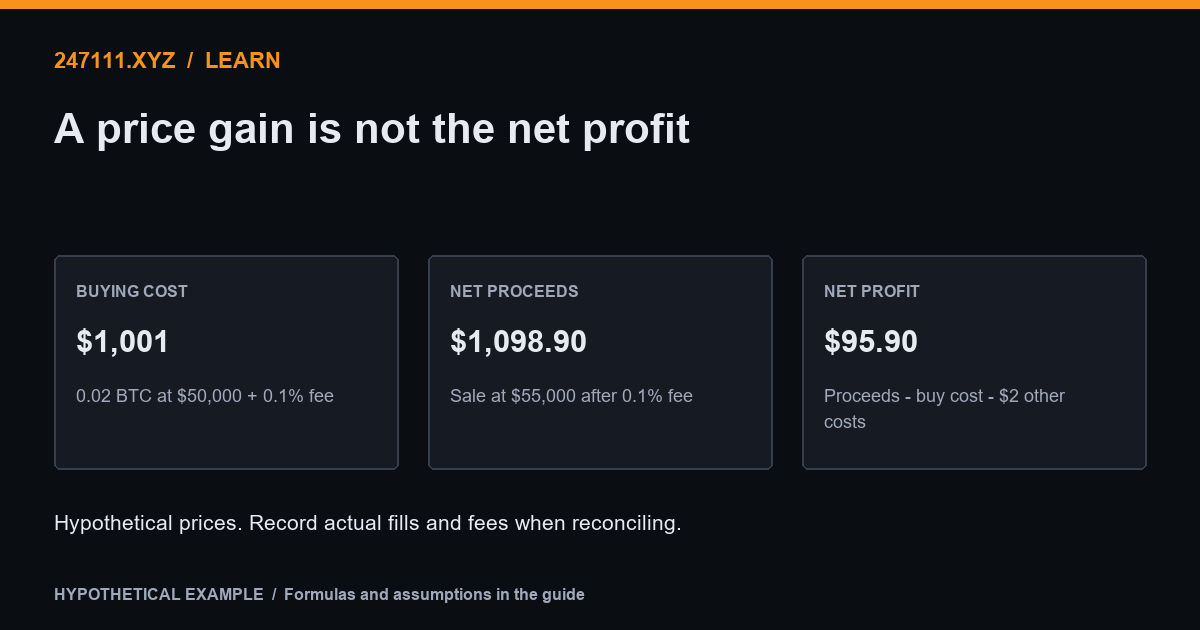
Suppose you buy 0.02 BTC at $50,000 and later sell at $55,000. Both trades have a 0.1% fee paid in dollars. You also assign $2 of other costs to this trade. These prices are examples, not current quotes.
| Item | Calculation | Amount |
|---|---|---|
| Purchase before fee | 0.02 × $50,000 | $1,000 |
| Buying fee | $1,000 × 0.1% | $1 |
| Sale before fee | 0.02 × $55,000 | $1,100 |
| Selling fee | $1,100 × 0.1% | $1.10 |
| Net profit | $1,100 − $1.10 − $1,001 − $2 | $95.90 |
Find the break-even selling price
Break-even exit = (buying cost + other costs) / [quantity × (1 − selling fee % / 100)]For the example above, $1,003 divided by 0.01998 gives a break-even price of about $50,200.20. Selling at the original $50,000 entry price would still leave a loss. Return on cost divides net profit by buying cost plus the included other costs; it is different from the percentage change in the asset price.
Which costs belong in the calculation?
- Use the fee rate that applies to your actual order type and account tier. A maker rate and a taker rate can differ.
- Add an allocated withdrawal or network charge only if you intend to include it in this trade. A charge shared across multiple trades needs a consistent allocation.
- Use the executed price when available. Slippage and bid–ask spread affect that price; avoid adding them again as a separate cost.
- Keep one quote currency throughout. USD and USDT values can diverge.
The calculator estimates one spot round trip. It does not determine tax liability, derivatives profit, borrowing interest or the result of partial sales. Keep your exchange fills and fee records for those cases. Save a scenario locally if you want to compare several possible selling prices without changing the original inputs.
What if only part of the holding is sold?
Apply the calculation to the quantity being sold and its chosen cost basis. Do not assign the full holding cost to a partial sale unless that is the method you intend to model. This calculator does not select an accounting method or determine taxable gains.
Check the inputs before comparing results
- Enter actual quantity after any asset-denominated buying fee.
- Check whether other costs are already included in your recorded cash cost.
- Keep fills, fee records and the quote currency consistent.
Use the related calculator to compare your own inputs. The result is an arithmetic estimate based on the assumptions above.