Average entry price versus break-even price
Work out a weighted average from several purchases, then account for buying fees and a future selling fee.
Weight each purchase by its quantity
Average entry = sum(quantity × price) / sum(quantity)Taking a simple average of prices treats every purchase as the same size. If you buy more units at one price than another, that method produces the wrong result. Use one asset, one quote currency and the quantities actually acquired.
A hypothetical two-purchase example
| Purchase | Quantity | Price | Cost before fee |
|---|---|---|---|
| First | 2 units | $100 | $200 |
| Second | 1 unit | $160 | $160 |
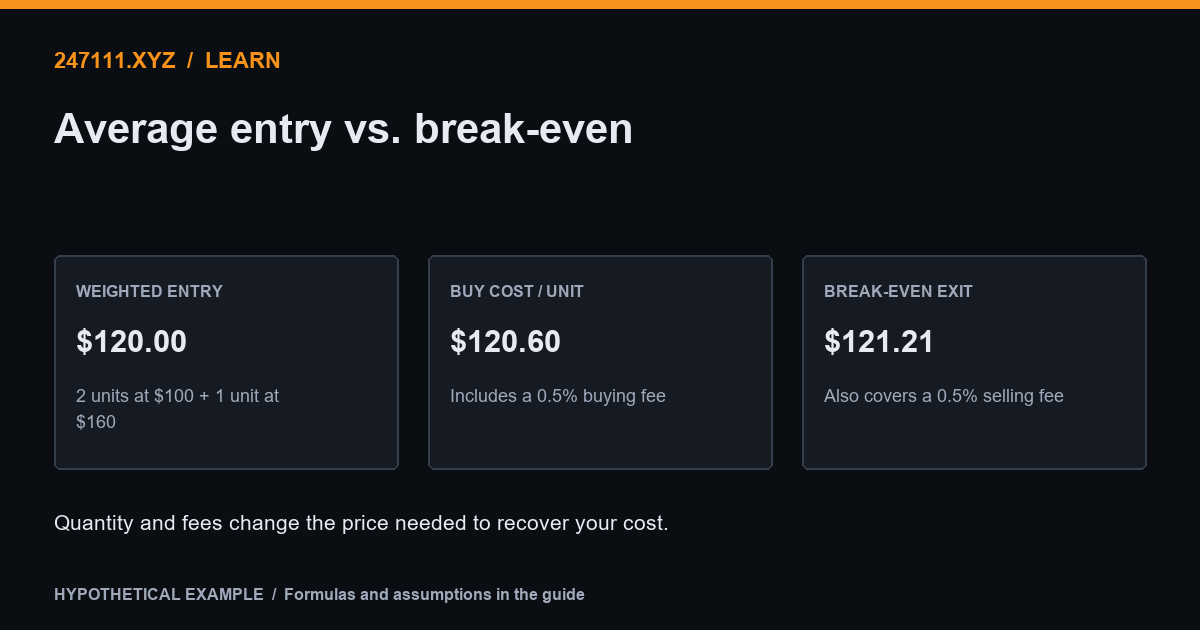
| Total | 3 units | Weighted average: $120 | $360 |
The simple average of $100 and $160 is $130, but the weighted entry is $120. The first purchase contributes twice as many units. In the calculator, add one row per purchase instead of combining them into a guessed average.
Move from entry to break-even
Suppose the buying fee is 0.5% on each purchase and paid in dollars. Total buying cost becomes $361.80. If selling will also cost 0.5%, the sale must recover that cost after the selling fee. The resulting break-even price is approximately $121.21 per unit.
Fee-adjusted cost per unit = total buying cost / total quantity
Break-even exit = total buying cost / [total quantity × (1 − selling fee % / 100)]
What happens after another purchase?
Adding units below the current weighted entry lowers the weighted entry; adding them above it raises the weighted entry. Neither action removes a previous loss. It changes both the amount at risk and the price at which the combined position would recover its cost. Compare total cost and total units alongside the new average.
- Enter fees paid in the quote currency using the fee percentage for each row.
- If fees were deducted in the purchased asset, use net units and actual cash cost; the row percentage alone cannot model that accounting.
- Do not mix purchases of different tokens, wrapped assets or quote currencies in one average.
- After a partial sale, use a consistent inventory method and remaining cost basis. This purchase-only tool does not select a tax accounting method.
Use it with the profit calculator
The average-entry tool estimates the combined purchase position. To compare a possible exit, use total quantity and your cost per unit in the profit calculator, with buying fees set to zero if those fees are already included in that cost. Counting those fees in both tools would inflate the cost. These are arithmetic scenarios, not advice to add to a position.
What if a fee is charged in the asset?
Use the units that remain after the deduction and the cash actually spent. A fee taken in the asset changes your available quantity. The cash-fee example above should not be copied unchanged into that case.
Check the inputs before comparing results
- Keep purchases in one quote currency before combining them.
- Use fee-adjusted cost once; do not add the buying fee a second time.
- Compare the combined quantity and total cost after each new purchase.
Use the related calculator to compare your own inputs. The result is an arithmetic estimate based on the assumptions above.