Impermanent loss compared with holding
Compare a full-range 50/50 constant-product pool with holding its two tokens, and understand the limits of a fee break-even estimate.
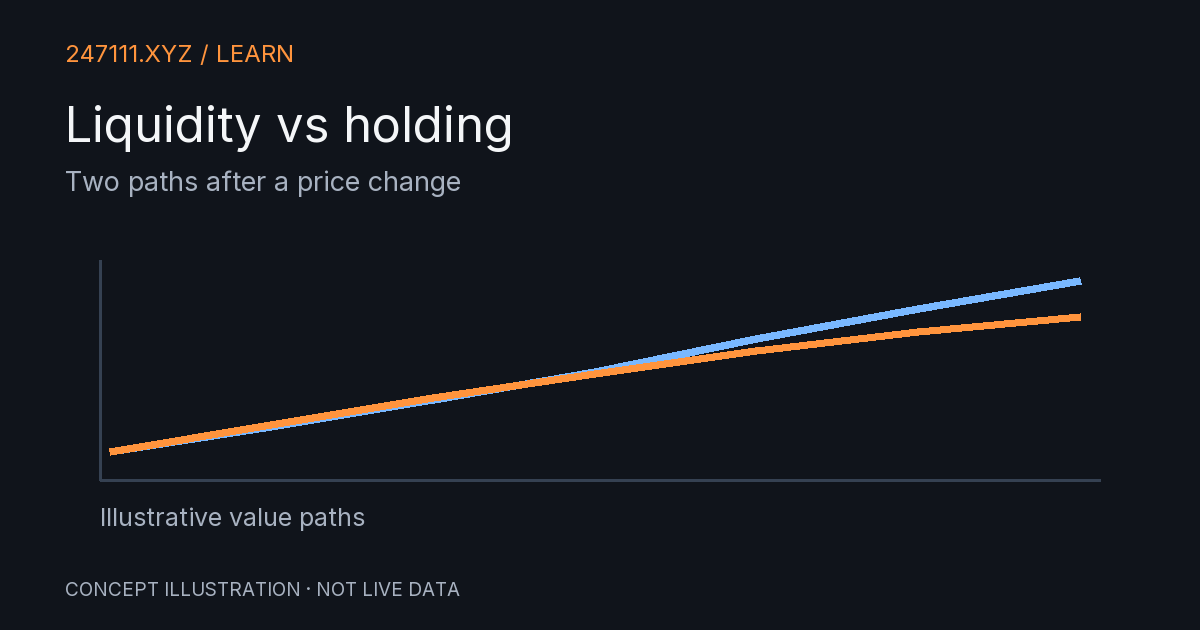
The model is 50/50, constant-product and full range
The calculator begins with equal USD value in two tokens and uses a constant reserve-product model at the new relative prices. This is a bounded scenario model derived from constant-product mechanics. It does not represent a concentrated-liquidity range, a stable-swap invariant or every pool listed in the DeFi directory.
Let a and b be the two token price multiples.
Holding value = initial value × (a + b) / 2
Pool value = initial value × √(a × b)
Shortfall = holding value − pool value
Compare both token prices
In the hypothetical example, $1,000 buys 5 tokens of A at $100 and 500 tokens of B at $1. If A rises to $200 and B stays at $1, holding is worth $1,500. The modeled pool is worth about $1,414.21, a shortfall of $85.79 or 5.7191% relative to holding. The pool still gained about $414.21 before separately entered fee income.
Fee break-even is a separate assumption
The model adds net USD fees paid outside the reserves. Adding $50 gives about $1,464.21, still $35.79 below holding. About $85.79 of net fees would close this example's gap. It does not forecast fee income or compound fees into the pool. Incentives in another asset, liquidity changes, protocol losses, taxes and transaction costs are excluded unless already deducted from net fees.
Use the impermanent loss calculator with positive starting and ending prices for both tokens. The [DeFi workspace](/defi) provides research context; a protocol name or TVL does not establish that this model applies to its pools.